Editorial http://www.tribune.net.ph Fri, 24 May 2013 15:55:55 +0800 Joomla! - Open Source Content Management en-gb Games Brillantes plays http://www.tribune.net.ph/index.php/commentary/editorial/item/14456-games-brillantes-plays http://www.tribune.net.ph/index.php/commentary/editorial/item/14456-games-brillantes-plays

Election watchdogs seem to be merely waiting for the smoke to clear up in the recent elections before filing the various cases that have lined up against the Commission on Elections (Comelec) for the disastrous conduct of the recent elections.
From the absence of the required integrity checks to the massive breakdowns of the precinct count optical scan (PCOS) machines, pre-programmed memory cards, the delay in the transmission of results, and the mad rush in the proclamation of the candidates, all these and many more are expected to face legal challenges.
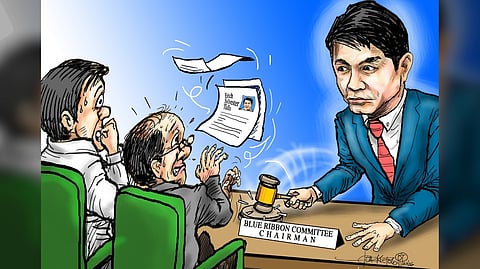
Comelec chairman Sixto Brillantes Jr.’s cavalier manner of dismissing the complaints as nothing but efforts to discredit the Comelec and the automated elections process should also be brought to question, if not legally, then through a legislative inquiry.
Brillantes seems more interested, for instance, in shielding Smartmatic from public criticisms on its faulty system more than guaranteeing the integrity of the electoral process.
When questions were raised on the inability of Comelec to present the source code of the PCOS machines for inspection of political parties and technology experts, the blame was mostly directed at software supplier Dominion Voting Systems and not Smartmatic, which was the seller of the PCOS machines.
The PCOS machines and the, automated polls system was first leased from the Smartmatic-TIM consortium in the 2010 elections for something like P11 billion and it was sold to the government for an additional P2 billion before the 2013 elections.
The Smartmatic system was already found to be full of defects in the 2010 elections and many of the serious issues raised against its use were never resolved up to the present.
The legal suits that will be filed against Comelec is necessary if only to assure that the next presidential elections wouldn’t have the same disastrous fate as that of the previous two elections.
The absence of an assurance on the reliability of the Smartmatic system poses questions on the beneficiaries of the defective results including Noynoy.
The resolution of the questions thus is necessary to clear up doubts on those now who have been seated into elective posts.
The haste at which the 12 senators were proclaimed will likely be the first challenge that Comelec is expected to face which many, even including former Supreme Court Chief Justice Artemio Panganiban who said the Comelec proclamations were done with undue haste and had no legal and factual basis.
Some of the proclaimed senators expressed reservations over the rush in which Comelec did the ceremonies but they were threatened or blackmailed by Brillantes to submit to his whim or risk not being proclaimed at all.
The losing candidates also have all the reason to file a protest particularly those in the Senate race with the probability of winning had the election process been done in an orderly manner.
Brillantes, in rejecting all the complaints, is not doing any service to the electoral process since the lingering doubts in the conduct of the 2010 automated elections were further reinforced by the same problems that recurred and proved to have worsened in the just concluded exercise.
Even the constant threat of Brillantes to resign if he is proven wrong on most of his actions is not a justification to let go of the valid arguments pointing to a failed election.
Brillantes knows that the legal challenges are coming his way in volumes.
He also knows that time is in his hands with the slow grind of the judiciary in this country.

]]>
editorial@yahoo.com (Tribune Editorial) Editorial Fri, 24 May 2013 08:00:00 +0800
Apologize, for crying out loud http://www.tribune.net.ph/index.php/commentary/editorial/item/14412-apologize-for-crying-out-loud http://www.tribune.net.ph/index.php/commentary/editorial/item/14412-apologize-for-crying-out-loud

Where is the logic in the Palace rationalizing for an indefinite period whether or not it should issue an official apology of Noynoy to Taiwan to end a needless international conflict?
It seems that Malacañang has lost all its mental faculties in the manure that had piled up out of its hubris to withhold a civilized act.
The death of the Taiwanese was an accident as a result of that country’s fishing vessel intruding into Philippine territory as claimed by the Philippine Coast Guard and which needs proving in the investigation being done by both countries. But the fact that a life was lost in the process evinces the need for a formal expression of regret that continues to be withheld.
The One-China policy is being bandied about as the complication in the process of handing out a government apology to Taiwan and that China, according to Manila Economic Cooperation Office (MECO), the de facto embassy in Taiwan, and some Palace officials,  may react negatively to a Noynoy apology and treat it as an official engagement of the Philippines with Taiwanese officials.
Leadership is all about taking the consequences of an act deemed right or proper and in the current rift with Taiwan, the only proper response from Noynoy is to issue an apology and deal with China later.
An apology cannot be taken as a break or even a threat to formal relations with China, which itself had sided with Taiwan on the issue.
The lack of reason in the stable of Noynoy sticks out like a sore thumb on the administration’s indecisiveness on the Taiwan issue.
The leadership vacuum was even mistaken by Taiwan as stubbornness of Noynoy in rejecting an act of contrition.
In a sense, the absence of any action from Noynoy after the death of the Taiwanese fanned the anger in the island territory which Filipino expatriates are now being forced to endure.
Taiwan said  the expressions of regret informally through the designated low-level emissaries were inadequate which Noynoy then responded to, by tiptoeing an expression of regret to maintain a safe distance which the Palace believes will prevent irritating China.
In the process, the belated apology sent through a MECO official further aggravated the sense of disregard Taiwan had accused the administration of Noynoy.
Worse, the government apparently rejected the holding of a joint probe on the incident after the Taiwanese team sent to the country left in a huff during the weekend, after some of its members told a media briefing that fisherman Hung Shih-Cheng was murdered by Philippine state forces.
The apparent outburst from the Taiwanese, however, resulted from what the investigators said was the refusal of  the Philippine government to cooperate in the probe.
They may be right at that, because from the start, there was that hard line position of the Palace and the Justice chief on their refusal for a joint probe, again using the One China policy, which is absurd.
The team was resent to the country by its government seeking a joint probe but was turned down with Justice Secretary Leila de Lima saying that a parallel, not a joint probe would be undertaken.
The probe, however, is more crucial for the interest of the Taiwanese who see themselves as the aggrieved party on the incident rather than the Filipinos, who all except for Noynoy’s pea-brained advisers acknowledge the need for a public apology as what Taiwan is demanding.
The absence of a resolute action from Noynoy, meanwhile, has been exploited by China to add pressure to the Philippines amid a territorial conflict.
The sum is a total loss for national interest.

]]>
editorial@yahoo.com (Tribune Editorial) Editorial Thu, 23 May 2013 08:00:00 +0800
Keeping with Sona tradition http://www.tribune.net.ph/index.php/commentary/editorial/item/14393-keeping-with-sona-tradition http://www.tribune.net.ph/index.php/commentary/editorial/item/14393-keeping-with-sona-tradition

It appears that Noynoy will stick to his worn-out formula of enumerating non-existent gains and head bashing of his opponents in the State of the Nation Address (Sona) which is now being drafted in preparation for the July inauguration of a new Congress session.

The speech, according to Noynoy’s Malacañang mouthpieces, will revolve around the supposed fiscal gains as a result of the sin tax reform measure.
Noynoy is also expected to spice up his Sona with another rundown of the record highs breached in the stock market in the first three years of his administration.
His Sona, as a result, will sound no different than those delivered during the term of former President Gloria Arroyo who claimed a list of achievements in the economic or fiscal fronts as a way to cover up her shortcomings in governance.
As Gloria’s faithful student, similar to the days way back at the Ateneo, Noynoy has been following in her footsteps, equating the bull run at the stock market and the strong peso with economic progress.
He is preoccupied also with the same zeal in obtaining an upgrade with the credit rating agencies, the recent investment level grades given to the Philippines will also predictably form a large part of Noynoy’s Sona speech.
The Sona won’t have any punch at all since there is none to think of during the past three years of Noynoy. The reference to anomalies won’t do this time since any reference to the past regime on anomalies becomes unbelievable this far in his administration.
The elections will also be mentioned expectedly as an affirmation of the mandate on Noynoy after the Commission on Elections (Comelec) ran roughshod over the counting of the ballots and blitzed the proclamation of the candidates despite the counting encountering several problems.
As a result, we now have “projected” senators whose legitimacy is in serious question.
The result was nine allies of Noynoy against three opposition members in the Senate but the fragile coalition in Team PNoy does not guarantee a majority for Noynoy when the Senate session resumes.
At most, the coalition may last until after the opening of session if Noynoy could swing a majority vote from among the coalition partners to put a loyalist at the Senate presidency. It would be safe to assume that the coalition, however, would not last particularly in the run up to the 2016 elections.
Noynoy, nevertheless, would claim that the result of the elections is a confidence vote even if, in reality, only one in three of the candidates whom he favored in the Team PNoy slate, made it to the Senate.
Noynoy’s weakness is in relations with the country’s neighbors which would likely be a topic that will be avoided in the Sona. The Philippines is in a conflict with China over disputes on the South China Sea and an incompetent handling of a shooting incident recently involving a trespassing Taiwanese fishing boat also has led to strained relations with Taiwan.
Noynoy treats foreign relations as an engagement with the United States and the America’s big European allies, to whom he runs when conflict arises in the Asian neighborhood.
The initial Sonas also dwelled on what was bruited then as inclusive growth that means the economic transformation being participated in by majority of the population which has not happened in the three years of Noynoy. There is growth but it is shared by only his rich business patrons.
The three years of Noynoy should be the topic in the Sona and it would be full of embellishments about keeping on the straight and righteous path and how being on path means economic salvation.
It would be, just like the two past Sonas, empty nonsensical rhetoric.

]]>
editorial@yahoo.com (Tribune Editorial) Editorial Wed, 22 May 2013 08:00:00 +0800
A boycott among OFWs http://www.tribune.net.ph/index.php/commentary/editorial/item/14335-a-boycott-among-ofws http://www.tribune.net.ph/index.php/commentary/editorial/item/14335-a-boycott-among-ofws

Lost in the din of the recent automated election and the confusion associated with it was the fact that the overseas absentee voting (OAV) was mostly a failure with a low turnout of less than 26 percent in all countries were there are Filipino workers.
The postal voting was even more disastrous with 26 countries registering zero turnout.
The Commission on Elections (Comelec) had attributed the snub to the lack of proximity of the voting areas to the Filipino workers which would be a difficult reason to accept since Filipinos are known to go out of their way and make their decisions known, particularly in choosing the country’s leaders.
In Saudi Arabia and the rest of the Middle East, which accounts for 40 percent of the registered overseas voters, the turnout was less than 15 percent or only 13,321 voters of 164,290 registered Filipinos in the three-city cluster composed of Riyadh, Jeddah and Al Khobar.
Only five percent turned out in Jeddah, eight percent in Riyadh and 10 percent in Al Khobar. The Dammam precinct reported a 10.96 percent turnout or only 2,723 out of 24,842 registered voters.
In Kuwait, a major destination of overseas Filipino workers (OFWs), the voter turnout was barely eight percent and in the United States, only 11 percent cast their votes.
The Comelec said the biggest turnout was in Hong Kong with a 34 percent participation of over 122,000 registered Filipinos.
In Europe, only 14 percent turned out to vote. In all, the total turnout was lower than in 2010.
Overseas Filipinos, when it comes to their sentiment on the future of the county, however, would always say that they would want to be part of shaping it.
But the OFWs have not been getting any attention from Noynoy lately which probably was a key factor for the low voters’ turnout.
OFWs are hailed as modern-day heroes but they are not accorded even the basic government service of having their travel papers facilitated. Instead they are charged with an increasing number of fees when they return home and get nothing in return.
Some Philippine embassies also offer little help to the Filipino expatriates and reports abound that they side with the foreigners who are the subject of complaints by Filipinos.
The falling number of overseas voters could be an indication of dissatisfaction from these groups of Filipinos effectively shoved out of the country to work because of the lack of local job opportunities.
The toughest ordeal for Filipinos working overseas is fending for themselves when confronted with a host of problems in the country they are working in since some  embassy officials are preoccupied with the many social commitments such as parties and dinners daily that come with their posts.
The low turnout can even be considered a form of a protest action from overseas workers. By not casting their votes, it appears that they are making known that things are not right under the dispensation of Noynoy.
While Noynoy  trumpets his straight and righteous path, Filipinos working abroad do not get a clear road to take through the country’s diplomatic stations.
Consider places such as the United States where the political awareness of Filipinos of their home country is updated daily yet the low turnout of voters for an exercise that had been open for them for a whole month.
For sure, there must be something amiss in the overseas workers view on the administration of Noynoy.

]]>
editorial@yahoo.com (Tribune Editorial) Editorial Tue, 21 May 2013 08:00:00 +0800
Invisible president strikes anew http://www.tribune.net.ph/index.php/commentary/editorial/item/14286-invisible-president-strikes-anew http://www.tribune.net.ph/index.php/commentary/editorial/item/14286-invisible-president-strikes-anew

The worsening rift between the Philippines and Taiwan over the shooting of fisherman Hung Shih Chen by elements of the Philippine Coast Guard (PCG) shared the same fate as in other past critical incidents involving the country: An invisible president.
The presence of Noynoy was again nowhere to be felt during the critical time that Taiwan was seeking a decisive action from the Aquino government on the shooting.
It was strangely Coast Guard officials who were countering the allegations from Taiwan that the killing was premeditated.
To appease Taiwanese officials, the government sent a half-hearted note of apology with head of the de facto embassy in Taiwan, in effect stating that the incident was unintentional with the government insisting, again irresolutely, that the country has the right to defend its territory.
The hardline position of Taiwanese President Ma Ying-jeou was expected since he has been receiving poor public ratings recently. Still, a Taiwanese national was shot and killed, enough for any president of any country to protest the death of the fisherman.
Noynoy appeared inclined early on to believe that the issue will blow away after an exchange of diplomatic niceties where the Taiwanese would accept the fact that the fishing boat trespassed into Philippine territory and the death was accidental.
But by biding his time before issuing a discernible response to the issue, Noynoy fanned public anger in Taiwan over the fisherman’s death pushing the unpopular president and prime minister to go with the Taiwanese emotional outburst and the demand for blood.
Ma sent a 13-man probe team to conduct a joint investigation with the Philippines on the shooting incident but not before issuing a statement that the Philippine government forces had murdered Hung.
The Taiwanese team which conducted the investigation can obviously only follow the verdict issued by its president and afterwards go home.
Meanwhile, the anger in Taiwan has been raised by several notches after Ma declared that the killing of Hung was pre-meditated.
The heated sentiment had placed at risk the welfare of nearly 100,000 Filipinos working in Taiwan as they appeared as targets for bodily harm by the Taiwanese.
Still no response from Noynoy amid the increasing incidents of attacks on Filipinos except for an advisory for them to stay indoors.
The Taiwanese president despite his having low public support, acted swiftly in responding to the death of the Taiwanse fisherman in contrast to the indecisiveness, which is a nature for Noynoy, in addressing the threats to the lives of Filipinos working in Taiwan.
Noynoy is now belatedly refuting the findings of murder by the Taiwanese probe team but nobody in Taiwan would not accept a different conclusion from Philippine authorities.
That is another area where Noynoy failed massively as the Taiwanese team should have been asked to withhold any public pronouncement until its findings are reconciled with those of their Philippine counterparts.
Again, there was no word from Noynoy or his officials if the local counterparts were able to form their own findings on the incident.
What appeared to have happened was that the Taiwanese were able to blitz into the country and do their assigned mission to make a public declaration of murder inside the Philippines and leave, all done under the nose of Noynoy who did nothing but be stupefied by the Taiwanese stunt.
It was the same response from Noynoy for every critical situation that faced his administration which is to initially stand open mouthed in amazement, then later issue later a feeble reparte.
Under Noynoy, it was always a crisis situation getting out of hand before he takes any discernible action.

]]>
editorial@yahoo.com (Tribune Editorial) Editorial Mon, 20 May 2013 08:00:00 +0800
Noynoying unified China, Taiwan http://www.tribune.net.ph/index.php/commentary/editorial/item/14258-noynoying-unified-china-taiwan http://www.tribune.net.ph/index.php/commentary/editorial/item/14258-noynoying-unified-china-taiwan

Noynoy had achieved something historic as a result of his inability to make a stand on the inadvertent shooting of the Taiwanese fisherman by the Philippine Coast Guard (PCG).

It took him more than one week to finally decide on issuing a half-hearted apology and even using the name of the Filipino people, which was of course rejected by the Taiwanese government, over the incident.
By being indecisive, Noynoy welded long feuding China and Taiwan together.
From the day of the incident, Noynoy was vacillating between standing his ground on the PCG’s insistence that it was the Taiwanese fishing boat to blame since it did not stop when it was flagged down in Philippine waters, and issuing a face-saving apology.
Apparently, the Chinese found an opening in the conflict that would achieve for it the proverbial two birds with one stone in winning brownie points with the Taiwanese public and pushing its diplomatic offensive against the Philippines further.
The diplomatic tussle with Taiwan would have been avoided had Noynoy responded quickly by asserting that there was a territorial breach and that the shooting of the Taiwanese was unintentional while at the same time issuing the government’s regret over the incident through emissaries.
It took more than a week for Noynoy to make a decisive move over the issue and sending the Manila Economic Cooperation Office (MECO) chairman Amadeo Perez to intercede in behalf of the country.
The move was deemed too late since Taiwan was already demanding that a more official form of apology is issued and handed to the Taiwanese government.
This is where China found a good vantage point to put increased pressure on Noynoy. China knew that Noynoy cannot officially issue a public apology to Taiwan lest he violates the one China policy and risk a bigger diplomatic friction.
China then exploited Noynoy’s dilemma by adding fuel to the fire issuing statements, in behalf of what it considered its province, to brand the shooting incident as barbaric.
In a sense, China is now asking Noynoy to also issue an apology to the People’s Republic of China over the death of the Taiwanese fisherman, who it considers as its own subject which further complicated the situation for Noynoy.
While it seems that China and Taiwan are speaking with one voice over the incident, diplomatic complexities point to Noynoy offending one or the other in issuing an apology to either.
It would be absurd for Noynoy for make a public apology to China since it would certainly offend the Taiwanese government and its people who are already ganging up against Filipinos working in Taiwan.
A direct apology to the Taiwanese government becomes further diplomatically appropriate since China had joined the fray and it is now speaking in behalf of Taiwan.
The diplomatic labyrinth, however, can be resolved only through a credible personal or private emissary of Noynoy who is connected with government.
During a similar gaffe with Taiwan in which Noynoy’s bungling officials in the Justice Department repatriated 14 Taiwanese suspected of running a telephone fraud scheme victimizing Chinese in Beijing, which also resulted in Taiwan’s suspension of the hiring of Filipino workers, Noynoy was able to send Mar Roxas who was still cooling his heels as a result of the appointments ban after an election.
The problem now with Noynoy is that all of his allies, friends, relatives and shooting buddies are now in government thus the dilemma of not having anybody who would satisfy the qualification of a private emissary.
Well if all things fail, Noynoy can send her sister Kris to do the apologies.

]]>
editorial@yahoo.com (Tribune Editorial) Editorial Sun, 19 May 2013 08:00:00 +0800
Smartmatic still for 2016 http://www.tribune.net.ph/index.php/commentary/editorial/item/14240-smartmatic-still-for-2016 http://www.tribune.net.ph/index.php/commentary/editorial/item/14240-smartmatic-still-for-2016

The Commission on Elections (Comelec) seems to be proceeding on the path of ignoring all forms of protests leveled against the automated elections and what had turned out to be a totally defective system wide open for massive electoral fraud, as it is being proven these post-election days.

The United Nationalist Alliance (UNA) and some independent poll watchdogs which rejected being co-opted by the Comelec, put their foot down on the chaotic way that the votes are being counted or miscounted.
The various reasons to which the Comelec has been resorting, primary of which was throwing the blame on the supposed weak signals of the telecommunications systems for transmission delays, were all exposed for what they are --- alibis --- with the Philippine Long Distance Telephone Co., which carried the system used for the precinct count optical scan (PCOS) machines, issuing a loaded statement that in essence said the Comelec should blame the defective Smartmatic system and not the PLDT network.
The telecoms giant said that in the May 2010 polls, “nearly 80 percent of the election results were successfully transmitted to the central data servers of the Comelec and (its citizens arm) the Parish Pastoral Council for Responsible Voting (PPCRV) 12 hours after the polling precincts were closed.
“From a purely telecoms standpoint, there is no reason why a similar, if not better, result should have been achieved in 2013,” a statement PLDT issued said.
After PLDT had upgraded its system several times including its latest multibillion-peso improvement of its broadband network, it would be hard to comprehend why the 2010 transmission was faster than in the just held elections.
It was obvious that the Comelec is trying to cover up for Smartmatic, the provider of the automatic elections system, and divert scrutiny on its decision to purchase the defective machines when there are far more reliable elections systems available and likely at a cheaper price.
The statements being issued by Comelec officials, spokesman James Jimenez, in particular, said that the PCOS-based system will be retained since the government does not have the financial capability to keep on replacing its automated elections system.
Jimenez said that the machines will undergo periodic maintenance to prepare these for the 2016 polls.
The question is, what is so valuable in the Smartmatic system for it to be maintained from the time Noynoy won the elections in 2010 and the next presidential elections in 2016?
The Smartmatic system was used in the 2010 polls, with the results also questionable and it seems that three years after, the whole system proved to have worsened and its defect multiplied instead of being upgraded by its provider.
Smartmatic and software provider Dominion Voting Systems were tied up in a legal tussle when the Comelec decided to buy the PCOS machines outright, thus ignoring the reliability of the system since the software being used can only be upgraded and fully maintained by the provider.
Thus the machines used a three-year-old system that did not get any form of maintenance updates which was the probable reason the machines mostly failed during the crucial day of the elections.
The Comelec, by refusing to resolve the various questions being raised on the defective automated polls system, is thus risking a prolonged legal tussle that may even put the results of the current elections at risk.
Smartmatic for the past two elections has had and still has, practical control of who gets the vote with the Comelec surrendering the polling system to the Latin Americans.
That would remain the case with the Comelec decision to maintain the system until 2016.

]]>
editorial@yahoo.com (Tribune Editorial) Editorial Sat, 18 May 2013 08:00:00 +0800
Were our votes counted? http://www.tribune.net.ph/index.php/commentary/editorial/item/14169-were-our-votes-counted? http://www.tribune.net.ph/index.php/commentary/editorial/item/14169-were-our-votes-counted?

A gap of about 12 hours, the time that Commission on Elections (Comelec) Chairman Sixto Brillantes Jr. said the poll official used for resting, was mysteriously missing in the timeline from the holding of the elections until the current count of the votes being done both by the poll body and its private arm, the Parish Pastoral Council for Responsible Voting (PPCRV).
The problem with the PPCRV is that it was never independent and is an adjunct of the Brillantes Comelec, thus, the public is again kept in the dark over what had transpired and is still transpiring during the counting process.
The presence of a top Smartmatic executive  at the PPCRV counting center during the mysterious lull in the the vote count has been raising a lot of questions on both the accuracy of the Smartmatic system’s output and the faithful transmission of the voting results.
Both the Comelec and PPCRV had placed the fate of the tally entirely in the hands of Smartmatic with the actual intervention that it is apparently being allowed to do right at the crucial stage of the actual tally.
It seems that the Comelec and the PPCRV have been covering up for  each other on the glitches and the outright failure not only during the voting but also afterwards in the transmission of the results that has led to the duplication of the counts, a repeat of 2010, which prompted the PPCRV to halt its tabulation, because the double count had become much too obvious and just as obviously, the PPCRV couldn’t continue with that fraudulent count then gave the lame excuse of formatting, when it was an arithmetical problem, i.e., padding of votes.
At almost the same time, the Comelec announced that it was delaying the official count of the ballots for the next day.
Until now, neither the Comelec nor the PPCRV has come up with an explanation of the mysterious time lag that had resulted in the slowdown of the tally.
The missing hours during the count was the main reason for what is now being complained as a much delayed process compared to the 2010 elections.
Former Comelec Commissioner Goyo Larrazabal said the pace of the counting is about 25 percent slower compared to the 2010 tally when 80 percent of the results already were known a day after the casting of votes.
With the massive failures of precinct count optical scan (PCOS) machines in the polling centers on election day, it would not be a  farfetched notion that the whole Smartmatic system is defective and needed tweaking several times.
The only alternative explanation was that the pre-programmed results in the memory cards were  inadvertently released too fast resulting in the tally overtaking the actual number of the votes then in the hands of the PPCRV.
A compact flash (CF) card found in the overseas absentee vote center in Hong Kong was found to contain pre-programmed results, according to the group Migrante.
The group said that if the CF cards used in the overseas voting have been manipulated, then it is possible that pre-programmed CF cards have been inserted in other PCOS machines.
Similar to the 2010 elections, most of the mysteries surrounding the PCOS machines and the automated elections system will be kept under the rug despite the many protests that are expected on the conduct of the just ended elections.
Just the same, Filipinos have left the fate of the exercise of their will up to the gods of technology.
Without a parallel manual count nobody will know if the Smartmatic system is reporting the actual results.
Nobody knows if Smartmatic had done the voting for us.

]]>
editorial@yahoo.com (Tribune Editorial) Editorial Thu, 16 May 2013 00:00:00 +0800
Paris of Asia http://www.tribune.net.ph/index.php/commentary/editorial/item/14139-paris-of-asia http://www.tribune.net.ph/index.php/commentary/editorial/item/14139-paris-of-asia

In his victory message, Manila Mayor-elect Joseph “Erap” Estrada promised to turn the capital city as the Paris of Asia, which sounds like any other lofty promise of a politician who is currently immersed in the euphoria of winning.

It also comes off as something impossible considering the three years guaranteed term of a local official.
Erap said, however, that leading Manila would be his last hurrah, the crowning glory of his storied political career.
That indicated a desire to make his last stint in government as something which will carve his name in the annals of history.
Since he was released from prison on politically-motivated charges that emanated from the 2001 power grab that had installed President Gloria Arroyo, who carved her name in history as a most unpopular Philippine president, Erap was yearning for a political payback.
In his short term as president of a little more than two years, Erap initiated a government that had the poor at its center.
His populist approach to governance so alarmed the status quo that culminated in the 2001 coup dressed up as a popular uprising.
He had in his presidency set an agriculture-led economic program that would have spurred growth in the countrysides and provided a sustainable source of economic growth.
The payback he wanted was not revenge but to complete what has been started.
Estrada had always regarded the poor as his source of political strength, thus, his desire to uplift their lives through the help of government.
The promise of turning Manila into a cosmopolitan city which will be the toast of Asia within three years would be key in providing the needed resources for the city to fund projects that would improve the lives of the majority of its residents.
While his term may only be for three years, Estrada’s vice mayor, Isko Moreno, appears to be in tune with the new mayor’s vision, earlier saying that even a year prior to the elections, he and Estrada had asked for a feasibility study on how to solve the problems of Manila. With a partnership in the city government holding, what Estrada starts, Moreno will likely finish.
Estrada likely is looking at a welfare system that would take care of the needy and the elderly that would require vast resources considering its 1.7 million population most of whom lives in destitution.
The glory days of Manila prior to the second World War saw it as a center of trade and commerce in Asia, and it was considered then next to Tokyo, the most modern Asian city.
Its stature had slid since then, and even within the country, it has been surpassed by cities such as Makati, Quezon City and even Cebu City as centers of commerce and tourism.
Manila appears to have clung to its distinction of the capital city for the only reason that the seat of government is located in it.
Erap said his being born in Manila made him aware of the problems that it faces and that knowledge is matched by his desire to rebound from an interrupted drive to serve the nation.
His predecessor, Alfredo Lim, is said to be credited for bringing back peace and order in Manila, for which its residents remain indebted, but Erap had committed to bring back its prime stature in the country if not Asia.
The target he had set is a mountain to climb but Erap has a reputation of a sure winner.
Manila as Paris, Mayor Erap has a big job ahead.

]]>
tdtadmin@localdomain.com (Admin) Editorial Wed, 15 May 2013 00:00:00 +0800
Dastardly deeds abound http://www.tribune.net.ph/index.php/commentary/editorial/item/14116-dastardly-deeds-abound http://www.tribune.net.ph/index.php/commentary/editorial/item/14116-dastardly-deeds-abound

The pathetic efforts of the demolition team of Noynoy extended to breaking into the Senate Web site, if not using some Senate insiders to circulate forged press statements from candidates of the United Nationalist Alliance (UNA).
The targets of the bogus e-mails were Gringo Honasan, Migz Zubiri and Jack Enrile, who are likely to close out the last three positions in the Magic 12 to the detriment of Team PNoy candidates.
With Nancy Binay and JV Ejercito considered shoo-ins in the Senate race and the entry of the three will make it 7-5 which is too close to call for Noynoy and his yellow minions in their goal of taking hold of, or their favorite word “reclaiming” the Senate.
With UNA candidates Ernie Maceda and Dick Gordon within striking distance of the Top 12 in the survey results, which are taken with a grain of salt entering into the actual elections, the likely equation remains a toss up between UNA and Team PNoy with even a probability of a 7-5 in favor of UNA.
The use of underhanded gimmicks such as text message blasts and lately the outright forging of e-mails showed the desperation of the administration in swinging a 12-0 sweep and failing that, a majority win for Noynoy’s candidates.
And yet they have the nerve to claim that they walk the straight and righteous path?
The marching orders were very clear from the start of the campaign period: Assure a sweep by hook or by crook since the opposition’s domination of the Senate is unacceptable and a repudiation of the three-year administration of Noynoy.
The Senate Web site break in was a genuine show of desperation in that the bogus press statement of Honasan supposedly stated his decision to back out from the Senate race while that on Zubiri, a supposed hate statement against Koko Pimentel, his perennial Mindanao rival.
The more virulent attack was on Enrile, which dug up past crime issues to which  he had been linked, and by the yellow mob, which includes the yellow media, but which had long been proven to have no basis against him.
The effort to bring down the three was apparently meant to clear the way for Riza Hontiveros, Bam Aquino and Jun Magsaysay who are the three favored candidates of Noynoy in the coalition.
The use of the Senate resources was particularly deplorable since it seems that the practices are back again to the supposed crooked ways of the past in terms of manipulating the government.
The Senate investigation into the incident ordered by Senate majority leader Tito Sotto will hopefully shed light into the hacking incident and expunge the chamber of the extensions of the “dirty tricks” department of Malacañang.
In Cebu, it seems that Mar Roxas had issued orders to the police to make life hard for UNA and their supporters to create a chilling effect on voters.
In Mindanao, the suspicious movements of the precinct count optical scan machines which are supposedly being replaced for defects have happened since last week. The Commission on Elections (Comelec) does not report where those supposed defective machines have gone and only gives an account of the arrival of the replacements.
Vigilance remains the key amid the likely continuing effort to again undermine the people’s will through the automated polls.
The dirty tricks are turning dirtier as the desperation of Noynoy and the yellow mob to control the Senate heightens.

]]>
editorial@yahoo.com (Tribune Editorial) Editorial Tue, 14 May 2013 00:00:00 +0800